Publications
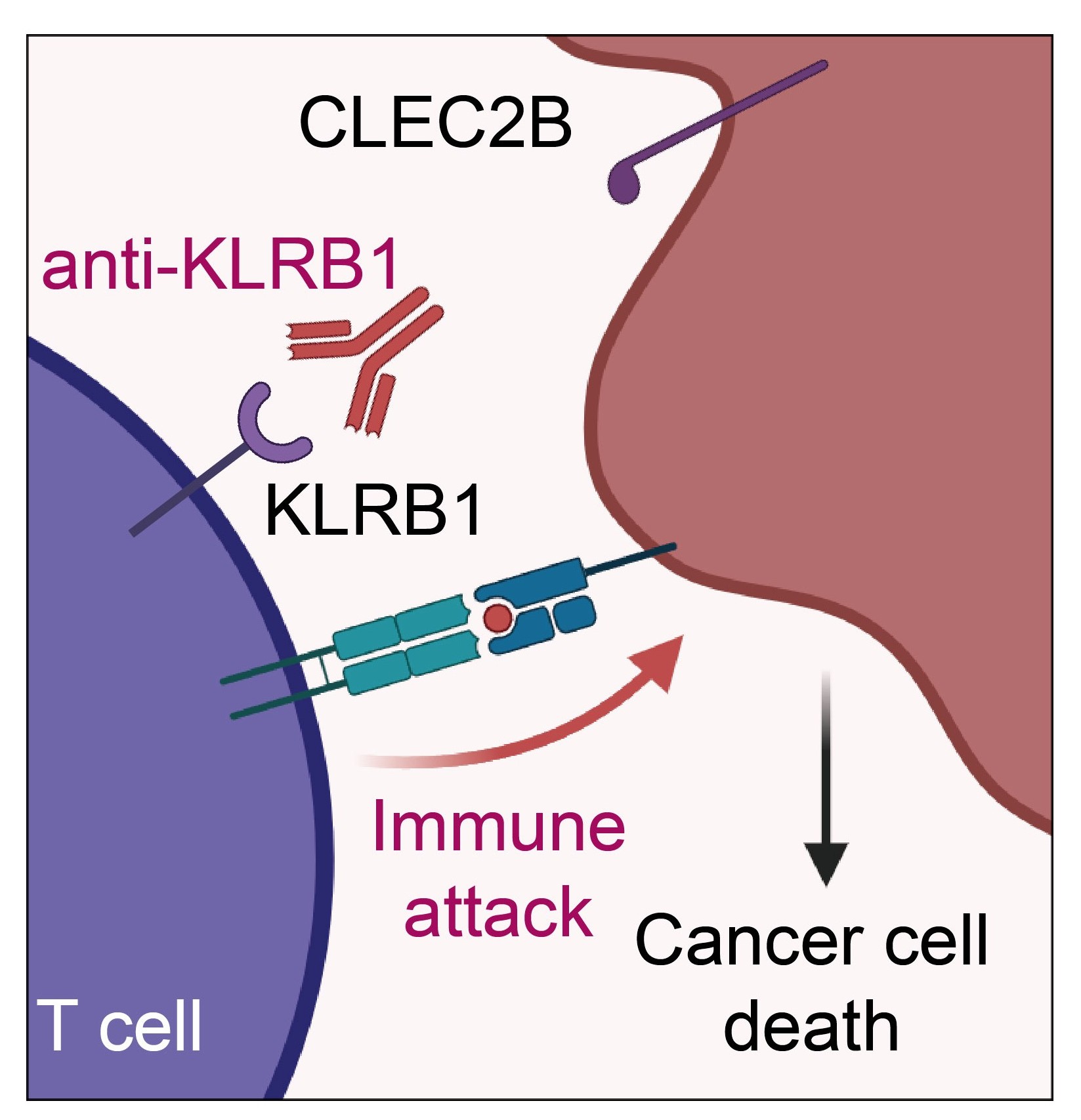
CLEC2B-KLRB1 axis acts as an immune checkpoint, governing the exhaustion of CD8+ T cells and their resistance to immune checkpoint blockade
Background Many patients with cancer benefit little from immune checkpoint blockade (ICB), a major obstacle to immunotherapy for decades. Finding alternative immune checkpoints that control CD8+ T-cell exhaustion is urgent if we are to improve the efficacy of immunotherapies, particularly in microsatellite stable (MSS) colorectal cancer (CRC) that is resistant to ICB. Methods Spatial proximity is essential for suppressive ligand-receptor signaling. Here, we mapped the spatial tumor microenvironment of patients with MSS CRC at single-cell resolution and analyzed the cells interacting with exhausted CD8+ T cells to identify immune checkpoint ligand-receptor pairs. To investigate the function of this previously unrecognized immune checkpoint, we performed validation studies spanning cellular experiments, mouse models, and clinical patient samples. Results We found that a subset of MSS CRC exhibits substantial CD8+ T-cell infiltration, but their function is suppressed. We identified CLEC2B (ligand)-KLRB1 (receptor) as a novel inhibiting ligandreceptor pair for CD8+ T cells. KLRB1 acts as an immune checkpoint receptor, increasing CD8+ T-cell exhaustion and facilitating immune escape in various human cancers. Binding of CLEC2B to KLRB1 initiates immunosuppressive signaling in CD8+ T cells. Clinically, CLEC2B-KLRB1 expression correlates positively with cancer progression and poor response to ICB, demonstrating that KLRB1+ CD8+ T cells are a key marker of the poorly responsive ICB subtype. Furthermore, blocking CLEC2BKLRB1 signaling with antibodies enhances the antitumor function of CD8+ T cells, providing a potential immunotherapy target for ICB nonresponders. Conclusions Our study revealed CLEC2B-KLRB1 as a previously unrecognized immune checkpoint axis that drives T-cell exhaustion specifically in ICB poor responsive MSS CRC. Blockade of KLRB1 with a therapeutic antibody reinvigorated CD8+ T-cell antitumor immunity, positioning this axis as a promising target for enhancing immunotherapy efficiency in malignancies, including CRC and other ICB-resistant cancers
Learn More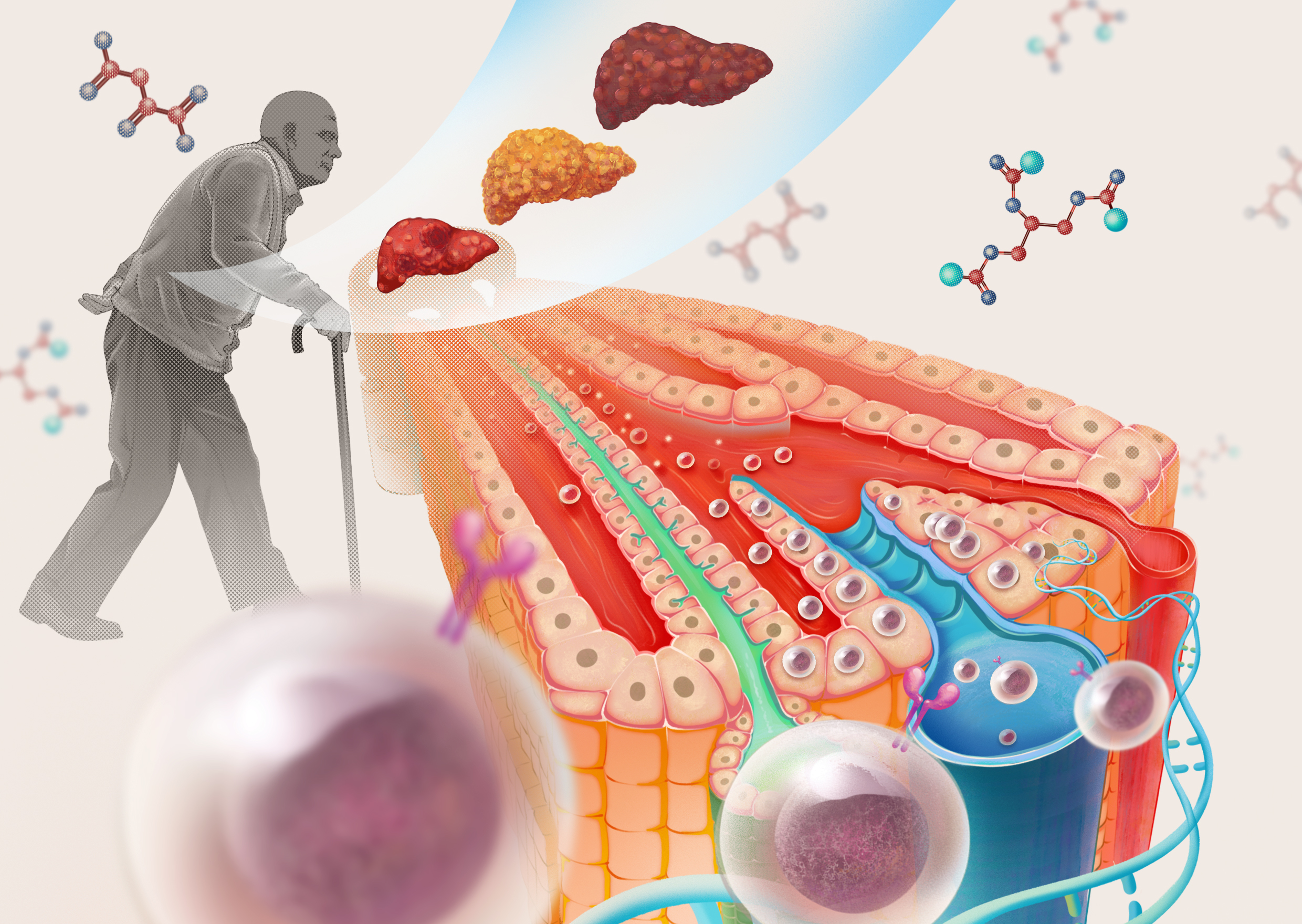
Spatiotemporal transcriptomics characterizes immune microenvironment during mouse liver aging
The liver is a major metabolic organ, responsible for synthesizing and breaking down diverse metabolites. Recently, the liver's immunological functions have gradually been unveiled: combating pathogens and maintaining tissue homeostasis. Age-related functional alterations in these immune cells emerge as potential drivers of hepatic dysfunction and age-associated pathologies. However, systematic investigations into spatiotemporal immune cell dynamics during liver aging remain limited. To address this gap, we analyzed young and old mouse livers using single-cell/nuclei and spatial transcriptomics, revealing T cells as the immune cell population with the most pronounced transcriptomic alterations, marked by enrichment of exhausted CD8+ T cells in aged livers. Spatial mapping showed exhausted CD8+ T cells accumulating in portal vein (PV) zone, co-localizing with periportal hepatocytes (PP hepatocytes). Up-regulation of LPIN1 in PP hepatocyte promoted T cell exhaustion. CD8+ T cell exhaustion was tightly associated with disease progression. Therefore, our findings suggest that targeting LPIN1 may alleviate T cell exhaustion, offering potential therapeutic strategies for age-related liver diseases.
Learn MoreFumarate integrates metabolism and immunity in diseases
Fumarate is a key metabolite produced primarily by the tricarboxylic acid (TCA) and urea cycles. In addition to having a metabolic role, its electrophilicity enables it to covalently modify cysteines; moreover, because of its α-ketoglutarate (α-KG)-like structure, it can also act as a competitive inhibitor of α-KG-dependent dioxygenases for epigenetic remodeling. Recent advances have broadened the role of fumarate as a bridge between metabolism and both innate and adaptive immunity, suggesting potentially important functions in anticancer immunity and autoimmune diseases. Here we review the connections between fumarate metabolism and immunity; we describe the mechanisms of fumarate regulation in cancer, autoimmunity, and other diseases; and we explore the clinical implications of fumarate and its esters for immunotherapy.
Learn More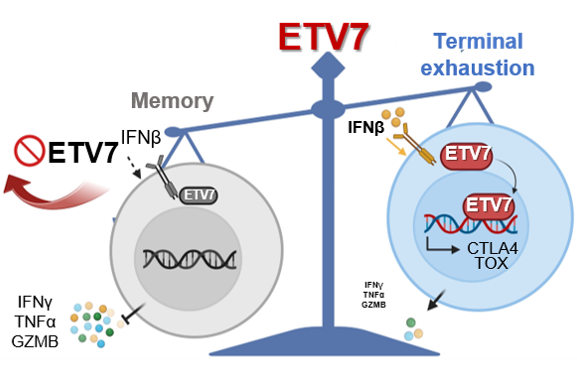
ETV7 limits the antiviral and antitumor efficacy of CD8+ T cells by diverting their fate toward exhaustion
Terminal exhaustion is a critical barrier to antitumor immunity. By integrating and analyzing single-cell RNA-sequencing and single-cell assay for transposase-accessible chromatin with sequencing data, we found that ETS variant 7 (ETV7) is indispensable for determining CD8+ T cell fate in tumors. ETV7 introduction drives T cell differentiation from memory to terminal exhaustion, limiting antiviral and antitumor efficacy in male mice. Mechanistically, ETV7 acts as a central transcriptional node by binding to specific memory genes and exhaustion genes and functionally skewing these transcriptional programs toward exhaustion. Clinically, ETV7 expression is negatively correlated with progression and responsiveness to immune checkpoint blockade in various human cancers. ETV7 depletion strongly enhances the antitumor efficacy of CD8+ T cells and engineered chimeric antigen receptor T cells in solid tumors. Thus, these findings demonstrate a decisive role for ETV7 in driving CD8+ T cell terminal exhaustion and reveal that ETV7 may be a promising target and biomarker for improving the efficacy of cancer immunotherapy.
Learn MoreDesuccinylation of inosine-5′-monophosphate dehydrogenase 1 by SIRT5 promotes tumor cell proliferation
Inosine-5'-monophosphate dehydrogenase (IMPDH) catalyzes the rate limiting step of de novo purine synthesis. Currently, it remains still largely unknown how this metabolic event is regulated in tumor cells. Here, we report that a deacetylase sirtuin 5 (SIRT5) may possess a regulatory effect on GMP anabolism by desuccinylating IMPDH1. We found that SIRT5 can directly interact with IMPDH1 and promotes desuccinylation on the N terminal of IMPDH1, thereby leading to increased IMPDH enzymatic activity, enhanced purine biosynthesis and promoted cell proliferation. Consistently, downregulation of SIRT5 expression results in decreased IMPDH1 activity and impaired tumor cell proliferation. Therefore, our results reveal that SIRT5-mediated IMPDH1 desuccinylation adapts purine metabolism for rapid cell growth, and could be a potential therapeutic target for tumor cell proliferation inhibition.
Learn More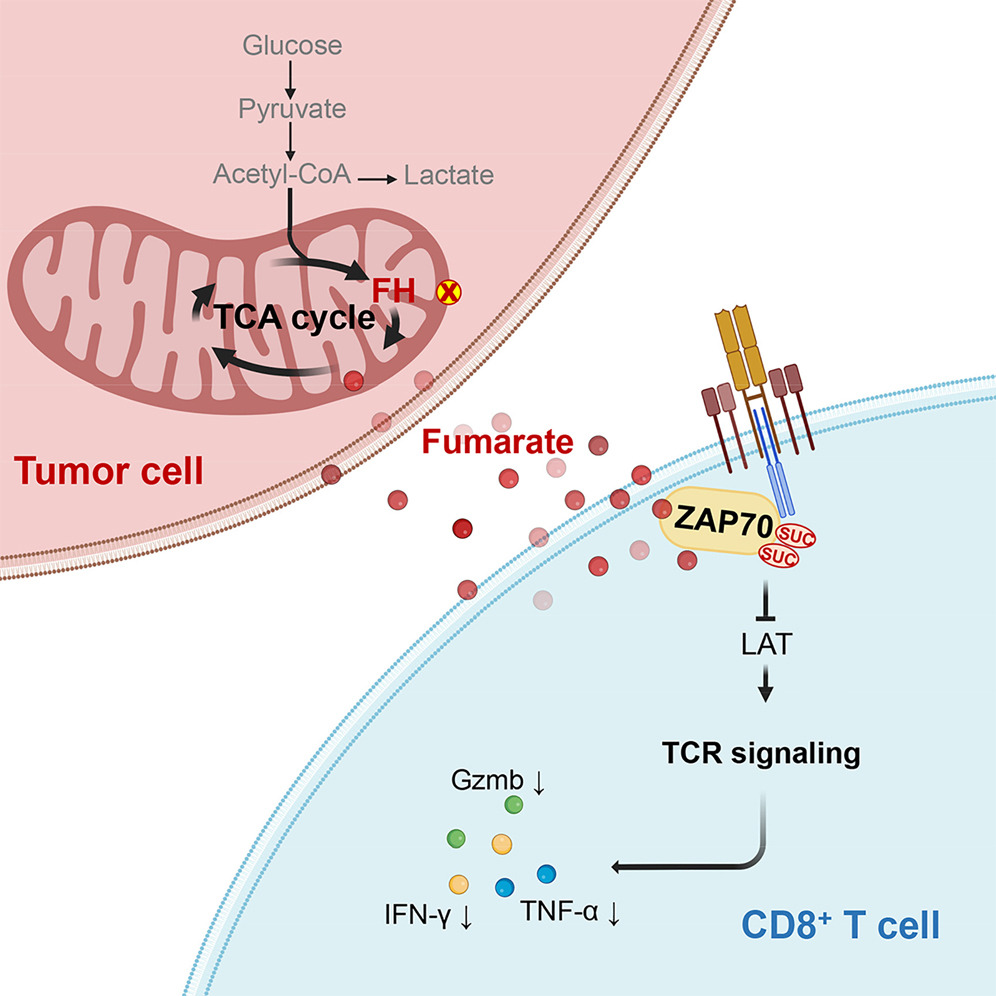
Cancer-cell-derived fumarate suppresses the anti tumor capacity of CD8+ T cells in the tumor microenvironmen
Metabolic alterations in the microenvironment significantly modulate tumor immunosensitivity, but the underlying mechanisms remain obscure. Here, we report that tumors depleted of fumarate hydratase (FH) exhibit inhibition of functional CD8+ T cell activation, expansion, and efficacy, with enhanced malignant proliferative capacity. Mechanistically, FH depletion in tumor cells accumulates fumarate in the tumor interstitial fluid, and increased fumarate can directly succinate ZAP70 at C96 and C102 and abrogate its activity in infiltrating CD8+ T cells, resulting in suppressed CD8+ T cell activation and anti-tumor immune responses in vitro and in vivo. Additionally, fumarate depletion by increasing FH expression strongly enhances the anti-tumor efficacy of anti-CD19 CAR T cells. Thus, these findings demonstrate a role for fumarate in controlling TCR signaling and suggest that fumarate accumulation in the tumor microenvironment (TME) is a metabolic barrier to CD8+ T cell anti-tumor function. And potentially, fumarate depletion could be an important strategy for tumor immunotherapy.Cell metabolism发表专文评述:Fumarate disarms CD8+ T cells against cancer. Jun 6;35(6):907-909.
Learn More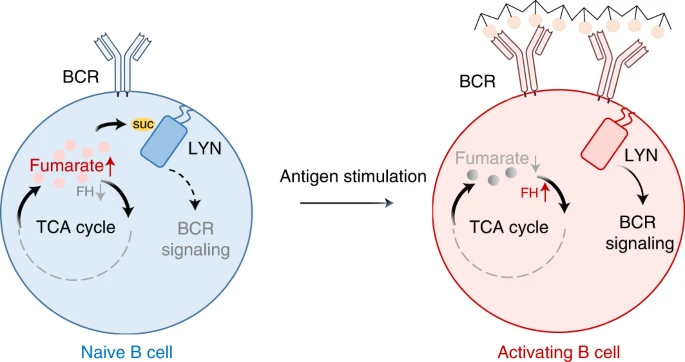
Fumarate suppresses B-cell activation and function through direct inactivation of LYN
Activated B cells increase central carbon metabolism to fulfill their bioenergetic demands, yet the mechanistic basis for this, as well as metabolic regulation in B cells, remains largely unknown. Here, we demonstrate that B-cell activation reprograms the tricarboxylic acid cycle and boosts the expression of fumarate hydratase (FH), leading to decreased cellular fumarate abun dance. Fumarate accumulation by FH inhibition or dimethyl-fumarate treatment suppresses B-cell activation, proliferation and antibody production. Mechanistically, fumarate is a covalent inhibitor of tyrosine kinase LYN, a key component of the BCR sig naling pathway. Fumarate can directly succinate LYN at C381 and abrogate LYN activity, resulting in a block to B-cell activation and function in vitro and in vivo. Therefore, our findings uncover a previously unappreciated metabolic regulation of B cells, and reveal LYN is a natural sensor of fumarate, connecting cellular metabolism to B-cell antigen receptor signaling.
Learn MoreTRIM21 and PHLDA3 negatively regulate the crosstalk between the PI3K/AKT pathway and PPP metabolism
PI3K/AKT signaling is known to regulate cancer metabolism, but whether metabolic feedback regulates the PI3K/AKT pathway is unclear. Here, we demonstrate the important reciprocal crosstalk between the PI3K/AKT signal and pentose phosphate pathway (PPP) branching metabolic pathways. PI3K/AKT activation stabilizes G6PD, the rate-limiting enzyme of the PPP, by inhibiting the newly identified E3 ligase TIRM21 and promotes the PPP. PPP metabolites, in turn, reinforce AKT activation and further promote cancer metabolic reprogramming by blocking the expression of the AKT inhibitor PHLDA3. Knockout of TRIM21 or PHLDA3 promotes crosstalk and cell proliferation. Importantly, PTEN null human cancer cells and in vivo murine models are sensitive to anti-PPP treatments, suggesting the importance of the PPP in maintaining AKT activation even in the presence of a constitutively activated PI3K pathway. Our study suggests that blockade of this reciprocal crosstalk mechanism may have a therapeutic benefit for cancers with PTEN loss or PI3K/AKT activation.
Learn MoreTryptophan derivatives regulate the transcription of Oct4 in stem-like cancer cells
The aryl hydrocarbon receptor (AhR), a ligand-activated transcription factor that responds to environmental toxicants, is increasingly recognized as a key player in embryogenesis and tumorigenesis. Here we show that a variety of tryptophan derivatives that act as endogenous AhR ligands can affect the transcription level of the master pluripotency factor Oct4. Among them, ITE enhances the binding of the AhR to the promoter of Oct4 and suppresses its transcription. Reduction of endogenous ITE levels in cancer cells by tryptophan deprivation or hypoxia leads to Oct4 elevation, which can be reverted by administration with synthetic ITE. Consequently, synthetic ITE induces the differentiation of stem-like cancer cells and reduces their tumorigenic potential in both subcutaneous and orthotopic xenograft tumour models. Thus, our results reveal a role of tryptophan derivatives and the AhR signalling pathway in regulating cancer cell stemness and open a new therapeutic avenue to target stem-like cancer cells.
Learn More